
Please sign in to post.

Rental car or public transport: an indicator for countryside travelers in Germany

It is widely known that rental cars are not needed in German cities and towns and also that long-distance trains and buses are a good way to travel between them.

But what about traveling the countryside beyond cities and towns? Rental car or public transport is a sometimes raised question. As an indicator in which cases it can make more or less sense I like to share an article with a diagram. It shows the result of a survey: the ratio of people by state which feel disconnected from public transport.

The states with the highest ratio of disconnected felt people are Saxony-Anhalt, Lower Saxony, and Brandenburg.
The lowest unsatisfied area states are Hesse, North Rhine-Westphalia, and Mecklenburg-Western Pomerania behind the three city-states.

For travelers it can be an indicator that the higher a destination is listed in this graph the more a rental car can be useful.

Hope it helps a little bit.

Have safe and good journeys.
Posted by
8017 posts

It would be no surprise that dissatisfaction is higher in states with populations that are predominantly rural.

I don't think this phone survey offers much guidance to travelers. Residents have very different transportation needs from travelers, who probably don't even recognize the place names on the diagram (chart) as the names of the German states. US tourists are largely underinformed about Germany and have next to zero familiarity with individual states; they don't know which cities are in those states or the states' locations or their identities. Tourists in Munich or Füssen might know what state they are in. But ask one in Cologne, or Trier, or Dresden, or Tübingen, and they're clueless. For most, there's the state of Bavaria, and the rest of the country is just "Germany."

The DB site is probably the best tool for determining the ease of using public transport in any given area.

Posted by
11461 posts

I agree with Russ that something like this is really going to be more useful for residents as opposed to tourists, who have different needs.

That said, I did notice that one of the lowest dissatisfied states was North Rhine-Westphalia, which was the only state where I needed to rent a car when I was there. The town I was staying in had access to trains but the station was shared with another town and was almost 3 miles from the town center. So for me, it was easier to rent a car for the four days I was there

Posted by
8017 posts

The town I was staying in had access to trains but the station was
shared with another town and was almost 3 miles from the town center.

Sounds like you probably had bus access to the shared station, which is maybe a nod to convenience that's sometimes better to avoid.... but typically, any town in Germany that close to a rail station offers bus transport on some level to the station. Baden-Baden comes to mind here. Yes, it has a station, but riding a bus to it takes 20 minutes, making it a possible - but undesirable - base town for outings by train. I wouldn't be enthusiastic about making that bus trip both before and after each outing. Rail users should probably book elsewhere in this area.

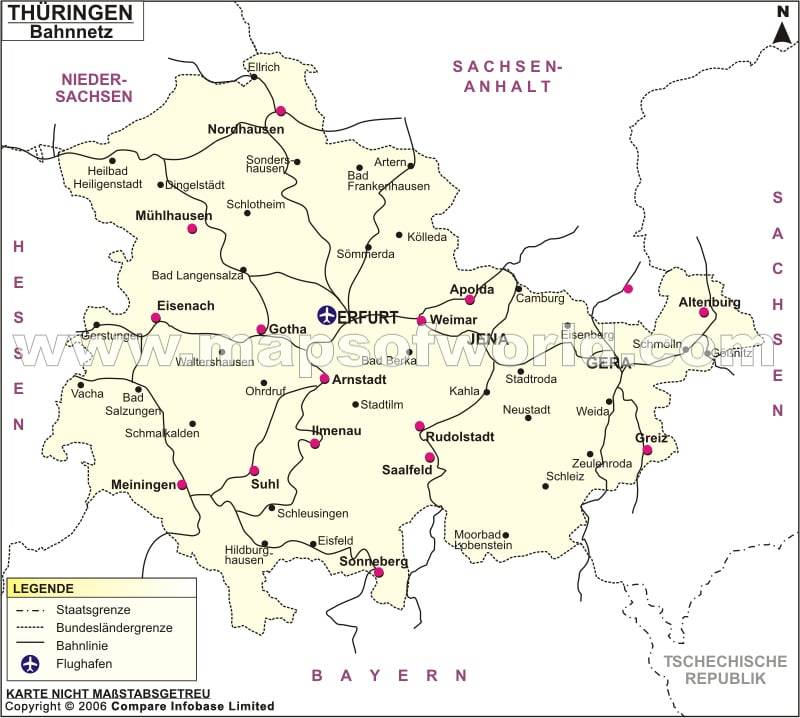
The German public's expectations of public transport are much greater than those of Americans, as a rule. Most of us would be shocked by the density and efficiency of German public transport, even in a "low-satisfaction" state like Thüringen, which is blanketed with train routes serving dozens and dozens of tiny towns:

https://images.mapsofworld.com/deutsch/thueringen-de-rails.jpg

Posted by
12 posts

I live in Germany, and have spent most of my time in rural Rheinland-Pfalz and the Freiburg and Stuttgart metropolitan areas in Baden-Württemberg, and my experience is more or less this:

If you live in a small town and want to travel to adjacent small towns and/or the nearest major metropolitan area, the public transit is great. Connectivity by bike paths is also fantastic. When I want to do little day trips by myself to explore (I live in a small town), generally the most efficient thing to do is to ride my bike to the train, ride the train to the town I'm interested in, and then ride my bike around the town or to whatever the nearest landmark is. It's pleasant, it gets you exercise, and you never have to worry whether you can find parking anywhere close :-P

If you want to travel from one major city to another, the ICE also fantastic, so much faster and more efficient than driving, also usually cheaper than gas.

If you want to travel from a small town in one major metropolitan area to a small town in another major metropolitan area, trains/public transit are a royal pain, and you are much better served with a car. Thanks to the amount of backtracking and train transfers involved, it takes about twice as long by train as it does by car, to, e.g. go visit my in-laws. And even then it's a 10 minute drive from their tiny town to the nearest train station. That, and wanting to pick up groceries and furniture easily, were the main reasons I bought a car.

...but still I only drive it maybe once every week or two, and it's bike, bus, or train for everyday life, since they are by far the more convenient options.