Please sign in to post.

Travel times when driving

I have been planning a 2-week driving tour of France in April 2027. It will be a shortened version of the 3-week "Whirlwind" tour in Rick Steves France book. After setting a schedule based on the timing for drives from city to city (either on the maps or in the chapters by region) and tours in the book, I now read in the Transportation section of the Practicalities chapter a sentence which says, "First-timers should estimate how long they think a drive will take...then double it."

This has made me anxious that all my planning is wrong and that this driving tour won't work. Can anyone give me advice?

Posted by
7726 posts

Driving in a foreign country on unknown roads will inevitably take longer than you think. Even the more reliable sites like Google Maps and Michelin do not take into account traffic slowdowns, or accidents, or stops for gas or restroom breaks. And I wont get into unplanned construction detours or taking a wrong turn and getting temporarily lost.

We've done driving trips in several Western European countries, including France and have learned not to try to cram too much sightseeing into a single day, and to add a minimum of 25% to each stop and drive time on any given day.

What sources are you using to estimate your drive times and distances?

Posted by
18215 posts

Check driving times on GoogleMaps.
GoogleMaps estimates travel times at the time you check (on real time) so those may be subject to change depending on the time of the day. For example if you check the travel times when in France is night time the estimated travel times will be shorter than if you checked at the time when in France is commute time.
The other thing to consider is that GoogleMaps (or any platform) uses the average time and speed of current (users) who are driving at the time you check and send the signal back to Google. However current users are generally local drivers who are familiar with the roads and therefore maintain an average speed that is higher than the one someone who's not familiar with the roads will maintain. In other words you will probably drive slower than the average driver (likely a local) on that road.
However doubling that time is a wild exaggeration. Just add 15%-20% to what GoogleMaps says, and you can rest assured you will be in the ballpark of what you (unfamiliar slow foreign driver) will need for the same distance.

Posted by
146 posts

Another tip when using Google search from N. America to calculate European driving times, keep in mind that unless specifically prompted otherwise, Google search will return those estimates based on the current time...which could be middle of the night in the destination country when traffic is much lighter than the time at which you'll actually be driving.

Posted by
1786 posts

Try to arrive at your final destination check-in by Sunset. Everything is harder find in the dark. That way you can have a nice meal and maybe some local entertainment that evening before you are too tired to enjoy it. We have stayed at Farmhouse B&Bs and got to have drinks with fellow guests in the lounge after dinner. Sometimes we just wanted time to take a bath and put our feet up and plan the next day. Bon Voyage!

Posted by
3645 posts

We have usually used Michelin.com for route/timing suggestions, and, like the above posters, add 15-25% on to their times, to allow for gas/food/comfort stops, and the occasional traffic tie-up, especially around cities. Doubling a time is too much, unless there is some extraordinary event. The michelin.com site often shows two or three route options. We usually plan for a maximum of four hours driving in a day. For example, we left a Paris suburb about 8 a.m., stopped in Giverny to see the gardens, ate lunch at the cafe there (spent 3 1/2 hours there total), then drove on to Rouen and got there in the afternoon. After finding parking and checking into lodging, we had time to see the cathedral, wander the old part of town (clock, etc.), see some Joan of Arc sights, and have a nice dinner. Next day we left and took the D982 to Bayeux, meandering, stopping at Jumiege Abbey for an hour, checking out some personal spots of hubby's family in Villequier. It would have been a 2 hour drive (about 100 miles), but we took five hours, only about three behind the wheel, following the Seine River a good part of the way. Do be aware that times on map sites and guidebooks give the time for driving on the Autoroutes, not the more interesting D roads. Get some Michelin paper maps to get an idea of different routes than what the computer says. Also, don't forget to factor in the time it takes to find your lodgings and parking, and check in. And on departing a place, checking out and finding your way out of a city. (Some cities make it easy, some just the opposite.) Tack an hour onto the arrival and departure times you are figuring as "transit" time between cities. If it takes less time, you have bonus time! If not, you aren't being stressed by being behind your schedule. This works for us, and we have driven a lot in France, through many regions. We always try to allow for extra time so that we can stop and check out something that catches our eye en route.
I am curious as to what your route is, and where you plan to visit. Do your two weeks include your arrival and departure days, or are they extra (total 16 days)?
Lucky you to be able to explore such a wonderful country! Just be sure not to spend it all behind the wheel.
Amusez-vous bien!

Posted by
4242 posts

I suppose the estimate of doubling the travel time only applies if you're doing sightseeing. If you're just going from point A to point B like a local FedEx driver who's on a tight schedule, as a newcomer you can just add about 15% to that local driver's normal time, provided you don't stop to eat or search for a restroom.

That said, there are some things no GPS, Google, Michelin or whatever can give you precisely.
For instance, on summer weekends, there are massive traffic jams in certain parts of France. A trip scheduled for 3 hours can take twice as long, or even more. There's even an official traffic forecast calendar, check out the one for 2026:

https://www.bison-fute.gouv.fr/IMG/pdf/Calendrier_Bison_Fute_2026.pdf

Needless to say, hitting the road during the black periods is definitely not a good idea.

The outskirts of major cities during rush hour are also something to factor in. A trip that Google estimated at 1 hour can easily take 2 and a half hours (I speak from experience).

The bottom line is that there are no hard rules, except for one: never be optimistic, because that's how you're guaranteed to lose.

Posted by
12 posts

Thank you for your reply. I will adjust my plans based on your input. So far, I have looked at travel times on the map which was included with my Rick.Stevesbook, the comments in his book related to specific cities, and a website called Rome2Rio.

Posted by
12 posts

Our trip is April 11 -27. We plan to visit Paris, Rouen, Bayeux, Dinan, Ambroise, Sarlat, Arles, Marseille, and Annecy. It will be driving most days, but with maybe 6 days without driving.

Posted by
7726 posts

Oh Geez, dont use the maps in the RS guidebooks. Those are meant for general, possible, route planning ideas and certainly not for planning detailed drives. Use real paper maps and real websites like Google Maps and ViaMichelin. And Rome to Rio?? It is perhaps satisfactory for seeing travel options from place to place, but it is notoriously inaccurate for actual planning.

Posted by
12 posts

Thank you. I do have a Michelin driving atlas of France. I will consult that next and adjust my timeline. All the responses have bee so helpful. Thank you again.

Posted by
4242 posts

Our trip is from April 11 to 27.

This will be during the 2027 spring break in France, so make sure to book your lodging well in advance. On the roads and at your destinations, you'll be surrounded by quite a few French travelers.

The A13 and A14 highways from Paris to Rouen use free-flow tolling. There are no toll booths, your license plate is scanned automatically. Don't forget to pay online within 72 hours. Otherwise, it's a €90 fine, which jumps to €375 if you wait more than two months (plus processing fees charged by the rental car company).

Avoid Rome2rio like the plague, it's completely unreliable. The best way to navigate rural roads in France is to watch for and follow the road signs, especially in the countryside. A GPS is a total idiot that will lead you right into the middle of nowhere on a dirt road, just because it thinks it's saving you 2 kilometers.

Posted by
2571 posts

Travel times on secondary roads can indeed bloat as a result of trucks, road construction, bicyclists, farm implements and other slowpokes. But the autoroutes move very quickly indeed. On most of them the limit is normally 80 mph (130 km/hr).

Posted by
4242 posts

But the autoroutes move very quickly indeed

That's the theory, provided there are no traffic jams caused by heavy traffic, roadworks, or an accident, not to mention the queues at the toll booths. On secondary roads, slowdowns are always temporary and have nothing to do with a motorway traffic jam blocking you for an hour or more.

Smart, forward-thinking drivers know how to use the signposted "Itinéraires Bis" (alternative routes).

https://static.wikia.nocookie.net/routes/images/5/58/XD41.png/revision/latest?cb=20200228093041

Posted by
3645 posts

ashworthteresa,
Speaking as someone who, with her husband driving, has pretty much travelled throughout most of France by car over several trips, I must say your plans for a two week trip in France tell me that you will only have time to dip your toes in a city. After you review the drive-time suggestions from the forum, and recalculate your behind-the-wheel times, you may want to drop some locations, such as the Dordogne area (Sarlat) or southern Provence (Arles, Marseille) and the Alps area (Annecy). A few years back we took some family members on a three week trip to introduce them to France. We spent a week in Paris, then spent 2 weeks driving though northern France. We did spend just 1 or 2 nights in places, but spaced out stops to be no more than a 2-4 hour drive apart. (One day we took 6 hours, but we did some sight-seeing along the way.) We covered Giverny, Rouen, Bayeux, Dinan, Pluneret, Saumur, a gite near Chambord, Beaune, Colmar and Reims. This was a counterclockwise route. If we had dropped the Alsace region (Colmar) and Reims, we might have had time for the northern part of Provence (Arles) and a stop in Annecy. As it was, we only saw parts of northern France, with Beaune being the furthest south. IMO, if only one person is doing all the driving, I would imagine that they would be somewhat burned out after three days of not being able to see the views along the way. and dealing with the traffic. (School holidays during part of your time there...lots of French families on the road then.)
Also, factor in your time to find your hotel and parking in each town/city, check in, check out and find your way out of the town/city the next day. Some cities are easy, some a real headache.

What you wish to do is doable. It just doesn't sound like a real visit to your planned locations. I wish you all the best in your planning and on your trip!

Posted by
12 posts

Yes, I agree. I did sit down and re-work our schedule. Now, I'm back to the drawing board to decide what we want to see most and what we should save for another trip.

Thank you all so much! Obviously, this is my first trip to France. It's great to learn from those who know.

Posted by
4242 posts

I took a look at the details of this 3-week "Whirlwind Tour of France" itinerary.

To name just a few examples from the first 10 days:

Day 1: Right after arriving at CDG airport, you drive to Bayeux. (which is strongly discouraged).

Day 3: Visit the Bayeux Tapestry (which is actually currently in London)

Day 5: Visiting the Loire Valley châteaux ( crammed into a single day).

Day 7: In the Dordogne, you visit a cave, take a gabare boat ride, possibly a kayak excursion, and tour châteaux. (Nobody can pull that off in one day).

Day 8: Is a 6.5-hour drive from Sarlat to Avignon, with a visit to Carcassonne thrown right in the middle (that's nuts).

Day 10: Visiting all of Provence is squeezed into a single day.

No sane person would do this, especially considering the hours of driving required between each day's activities. Even a professional driver would go on strike. :-)

Avoid plans like this, and get the idea out of your head that you need to do a loop all over France. You'll get just as much variety by sticking to just a quarter of the country.

Posted by
3645 posts

Theresa,
I am glad to see you are reworking your itinerary. We have done lots of road trips within California and all around the southwestern states and Pacific Northwest, and I can testify that those road trips are not at all like the road trips we have made in France. They are a completely different animal and comparisons with a day on the road in France don't really compute. JoLui's suggestion of just visiting about a quarter of the country is an excellent one. Think about what things are the most important for you to see and do, and what type of kicking back you might enjoy, find where they are, and see where places/sights overlap. (I guess I am thinking of a Venn diagram.) How do you see yourself in France? Sipping a glass of wine, visiting a cathedral, eating delicious food, admiring paintings and sculptures, strolling through beautiful gardens, being amazed by palaces and chateaux, exploring the countryside (valleys, rivers, coastlines, mountains)? Every place I have visited in France holds special memories for me, so I think wherever you decide to go will do the same for you. Amusez-vous bien!

Posted by
3645 posts

JoLui,
Where did you find this "Whirlwind Tour of France"? It is impossible without teleportation!

Posted by
3645 posts

JoLui, ashworthteresa,
Oh my! Oh, well, live and learn!

Posted by
7995 posts

Our trip is April 11 -27. We plan to visit Paris, Rouen, Bayeux, Dinan, Ambroise, Sarlat, Arles, Marseille, and Annecy. It will be driving most days, but with maybe 6 days without driving.

I am sorry, but this is an unrealistic itinerary for 14 full days. You would be much better off choosing between a "Western" route (Paris, Normandy, Loire, Périgord, back to Paris) or a "Southeastern" route (Paris, Provence, Alps, with the possible addition of Lyon and/or Burgundy and using the train between Paris and the latter).

Posted by
12 posts

Yes, based on all these replies, I'm working on a different plan that excludes some of cities. Thankfully I found this forum. I appreciate the input received from everyone.

Posted by
3357 posts

Do you have a day-by-day worked out itinerary which you could post? Many of us have been to France, and might have specific comments. Wife & I spent 2M in Bretagne, and did a trip to Carcasonne while there. We drove, and have a number of specific suggestions about driving.

1) We try to never stay fewer than 3 nights in 1 place. Packing and moving is a pain and you do no pleasure-seeking during this time
2) Get used to the round-abouts. These are all over France - near large cities, 1 every 2K is not uncommon. You must get used to this road feature - merge in smoothly with other cars/trucks
3) Parking in large cities can be expensive. In many cities, parking is charged during the day, but not after 6PM. In Carcassonne, our overnight parking was free. Spaces were usually available but were often snapped up quickly after 6 PM
4) Every small town has low speed limits - 30KPH on entry, up to 50, with speed bumps frequent.
5) Parking in small towns was never difficult, except on market day when it was impossible.
6) In cities, usually use either walking or the city transport system.
7) We saw exactly 1 set of gendarmes - a drunk-driving check in the smallest town in France that we were in.
8) Beware the speed zone signs - they warn you of speed cameras - be very sure to drive the limit until you see the camera pilon - 5 FT tall, black. on the side of the road. 2 M in France, 0 speeding tickets.
9) The most annoying part of driving was google maps. First, the French accent of the app was simply terrible. Second, Google maps is "road-name centric" - "take Avenue Marechal Foch" - well, these road names are simply not used. The best clue is "take the 2nd exit to Avenue Marechal Foch". Google maps was accurate both in time and in directions for us.

Posted by
12 posts

Based on your input and discussions with my spouse, here is my new plan. Let me know your thoughts:

4/11 - Arrive in Paris at 1pm, Rent a car and drive to Rouen for one night.
4/12 - Drive along the Route of Ancient Abbies from Rouen to Bayeau. Stay in Bayeau 4 nights
Tour Normandy sites and take a harbour tour
4/16 - Drive to Loire Valley to Amboise. Stay in Amobise 3 nights
Visit Chateaus, Take a wine tasting tour or go hot air balooning
4/19 - Drive to Paris in the morning, Fly to Annecy with arrival around 4pm. Stay in Annecy 3 nights.
Tour Annecy
4/22 - Fly to Paris with arrival around noon. Stay in Paris 4 nights
4/26 - Fly home

Thanks again for all your help

Posted by
3357 posts

I think that looks very do-able. You will enjoy staying in a place a bit longer, as it allows you to get to the 2nd level of sightseeing. Plus you can learn about the transport system. Good for you to overcome FOMO.

Posted by
4242 posts

Regardless of your choice to stay in Annecy, which I hope is personal and not influenced by some random marketing tactic, and since you want to make a huge jump on 4/19 rather than focus on two or three neighboring regions of France, I assume you’ve already figured out the timing to get from Amboise to Orly Airport, fly to Geneva, and then catch a transfer to Annecy.

Posted by
3645 posts

Your new plan sounds fine. Do be sure you aren't too tired from the flight to drive to Rouen on arrival day. And do fly from Orly as it is easier to get to from Amboise than is CDG. Have a wonderful time!

Posted by
37226 posts

I agree with the points made just above by Paul-of-the-Frozen-North about the required driving skills

a few that I consider critical:

Understand the National speed limits (and Departmental idiosyncrasies) so intimately they are in your blood so you don't need the (sometimes missing or vandalised) signs, and what a settlement name means on a sign and one with a red diagonal line.

Completely understand the meaning of a yellow diamond, and a line diagonally across a yellow diamond, and react appropriately when you see a sign reading, "Vous n'avez pas la priorité". Understand that if you wind up on the Boulevard Périphérique (usually known just as Périphérique) in Paris, the rules are upside down and the experience can be interesting.

Be ready when you reach a Péage (toll booth) to be in the correct lane for your method of payment. Understand that, like on a turnpike, sometimes you pay at a Péage and sometimes you take a ticket (ticket or billet). There are a few Autoroutes which are "Free Flow" where your number plate is captured by a camera and you pay on line. There will be signs on the side of the road - have your co-pilot make notes.

On the Autoroutes, at the Aires, service areas, both big and small, beware the "seat thieves" and at the smaller ones which often use the floor hole method, no seats at all. Practice holding a squat. Take tissues or a travel roll -sometimes there isn't any.

Get your IDP (International Driving Permit), one for each driver to be used with your home licence, before leaving home. If you get across the water without one you can be stuck.

The colour of the filling station hose and nozzle may very well be opposite or just different to what you expect. As they say, measure twice and cut once. Gasoline/Petrol is "Essence", Diesel is Gazoil or Diesel. Don't assume that gazoil is gasoline. It isn't.

Fuel is priced by the litre.

Rappel means the previously indicated lane or speed restriction still applies.

Understand the differences and driving style differences between A, N and D roads.

Keep right except to pass. No passing on the right. The French use their turn indicators differently. You'll be able to tell which country a car is from by its driving technique and skill without looking at the number plate.

Seriously - best to bone up.

Bonne Chance et Bon Voyage

Posted by
12 posts

Thank you everyone. In response to a few comments:
-The trip to Annecy is the only non-negotiable item for my husband. While I found flights which provide ample time, I did not realize they were flying into Geneva. Google flights said Annecy, and provided the airport code for Geneva. I just had not noticed that. So, there is more homework for me on that.

-Both my husband and I have started reading all the rules of the road. We will memorize as many as possible and create a cheat sheet to carry in the car. All your details were very helpful.

I am glad that I started planning early and am honored that you have all been willing to help me.

Posted by
2571 posts

One can secure rental cars on the French side exit from the Geneva airport. It's important to do that if you plan to travel predominantly in France. Annecy is a fairly short drive from Geneva.

Posted by
4242 posts

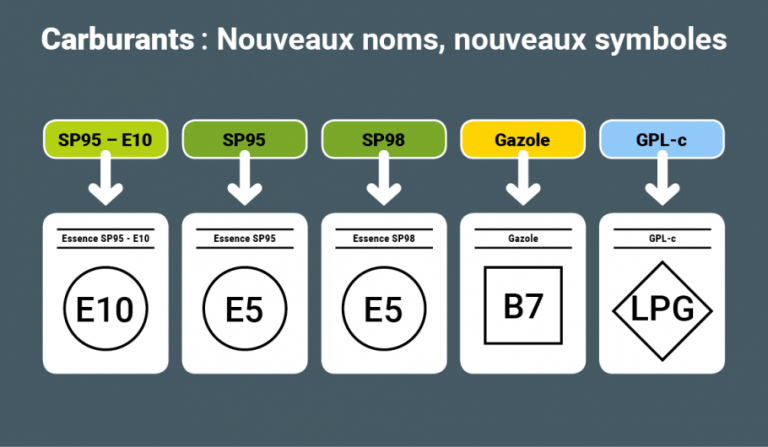
To add to Nigel's information, fuel types at gas stations across the entire European Union have been standardized for a few years now, coded by color and an alphanumeric identifier.

Green corresponds to unleaded petrol. There are two types of unleaded: SP98 designated as E10 and SP95 designated as E5.

There is also E85 superethanol fuel for vehicles specially modified to accept it (coded in blue).

Yellow corresponds to diesel fuel and is coded starting with a B (B7 or B10 depending on the biofuel blend rate).

https://www.avatacar.com/blog/app/uploads/2018/10/Noms-des-carburants-768x447.png

In any case, the fuel types suited for your car will always be indicated somewhere near the gas cap.

Following events in the Middle East, the price of a liter of unleaded fuel is currently, at best, a bit over 2€, while a liter of diesel exceeds 2.20€. The ultimate mistake not to make, as you can imagine, is obviously putting diesel into a car that runs on petrol, or vice versa.

Otherwise, driving is roughly similar to the USA with a few peculiarities in road signs, but the pictograms are generally self-explanatory. Some road signs are occasionally accompanied by text comments that are not easy for a non-French speaker to understand, like this one:

https://maps.app.goo.gl/cmFNCL24Ekh7KHnq8

or this one:

https://maps.app.goo.gl/ieg3XWLKTrQRiVFL8

Regarding speed limits, a sign indicating entry into a town or village (rectangular signs with the name of the town/village) implies a speed limit of 50 km/h.

As for roundabouts, it's super easy, you just have to follow the directional signs:

https://maps.app.goo.gl/Xdoxi2r6WfjnDzpT8

Posted by
3645 posts

ashworthteresa,
All the very helpful comments regarding driving in France (road rules, etc.) may seem hopelessly confusing and intimidating. Do not be discouraged. You will fairly quickly internalize some of them, like "priorite a droit", and the town signs (name of town on entering, name of town with a slash on leaving), and the speed limit signs. You will manage, especially with a good navigator riding shotgun.
As stated, when in the countryside, follow the road signs, esp. at roundabouts, not necessarily GPS. If you do see you took the wrong exit from one, as soon as possible return to that roundabout. Don't go driving far away from it which GPS may say. (Hubby did that once...what a time-wasting pain!)

Re speeding tickets, if you do go over the limit and are caught on a camera (sometimes not noticeable), be prepared to receive a notice and a charge from the car rental company a few weeks after you get home, then a notification of your speeding ticket from the agency concerned. The rental company is charging you for providing your name and info to the traffic agency. No way out of this. When you get the actual speeding citation, pay as soon as possible to avoid a hefty increase in the fine as time goes by. (I speak from experience, my own and others. This is not a scam. It is how speeding infractions are handled with rental cars.)
We have found the only pains of driving in France are getting into and out of and within cities, and finding parking within them. But it is like that in US cities too. (Looking at you Boston, San Francisco, New York, Phoenix, Las Vegas....etc.)
Happy travels!

Posted by
3357 posts

Traffic tickets: We were in France 2 months. We drove up and down Bretagne (which has a few special rules dating back to the point at which Bretagne was admitted to France). We were scrupulous about the announced speed zones - a special sign with concentric circles. When we saw these, we drove 3-4 KPH under the limit. We were in many many of these zones, and never got a single ticket. So, pay attention to the announced speed-test zones, and you should be fine. We drove the rest of the time about 10 KPH over the limit, which was not fast enough for a lot of other drivers.

Posted by
37226 posts

there are now more and more UNannounced speed zones in France. Best advice is drive at or below the limit. There is no built in fudge zone on speed limits. 50 means 50. 90 means 90.

Posted by
4242 posts

All fixed speed cameras in France, without exception, are preceded by specific road signs, this is a ministerial directive.

There are a few variations of these signs:

https://www.phonandroid.com/ces-panneaux-radar-vont-disparaitre-des-routes-en-france.html

However, there are speed checks conducted by mobile gendarmerie units that position themselves in hard-to-spot locations. These are not preceded by any warning signs.

There are also mobile unmarked vehicles equipped with speed camera, they can check your speed while driving, even if you are traveling in the opposite direction.

The tolerance margin for fixed speed cameras is 5 km/h for speed limits below 100 km/h, and 5% for limits of 100 km/h or higher. This means that if the speed limit is 50 km/h, you can drive up to 55 km/h without without triggering the speed camera. You are in violation at 56 km/h or above.

Exceeding the speed limit by more than 50 km/h results in a 3-month driving ban across French territory. If you are caught under these circumstances, you must leave the vehicle where it is, or find someone else to drive it for you.

Posted by
857 posts

This year I have driven 6500km - just over 4000miles - on two roadtrips in Germany and France.

My average speed for the more recent of them was 10 days, 3000km @ 67km/h (41mph). This despite 80% of my driving in Germany and 20% of my driving in France being on Autobahns and Autoroutes. There were 3 days in Germany that were mainly high-speed (average 140kmh/90mph when actually moving) 300km runs.

And don't forget, these are average speeds for time spent moving. In daily driving, not using Autoroutes, I average about 56kmh, or 35mph. I live in the country and drive a combination of national (N roads) and departmental (D roads) where the signposted speeds are 80 or 90 km/h. These are the speeds the mapping companies (and Google maps) use when calculating driving speed.

When planning a trip I plan for no more than 400 km a day. That gives me 8 hours ± behind the wheel, add in a couple of stops for sights and an hour or so for lunch that's a solid days work. A more relaxed day (better for when on holiday) is about 250km.

My car computer for the latest trip